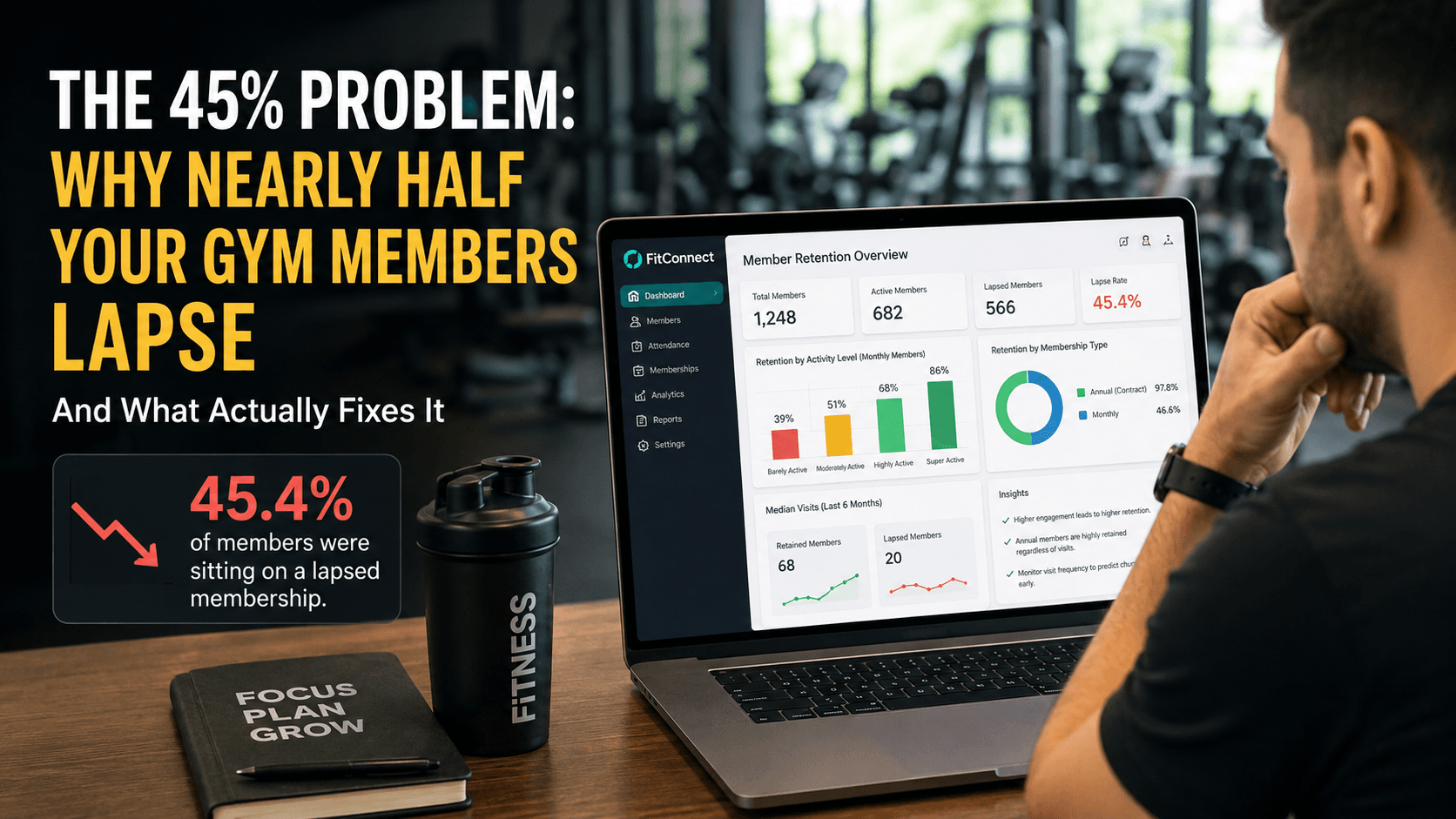
If you run a gym, you already feel the churn. What you probably don't have is the number behind the feeling. When we pulled twelve months of membership data from a mid-sized fitness centre in Homagama, the figure was stark: 45.4% of members were sitting on a lapsed membership — almost exactly in line with international attrition benchmarks that put annual fitness-industry churn at 40–50%. For a subscription business, that's not a rounding error. That's close to half your recurring revenue walking out the door.
The good news is that the same dataset shows exactly where the leak is, and it isn't where most owners assume.
Gym Member Retention Isn't About Demographics, It's About Behaviour
It's tempting to explain churn with demographics: "younger members just aren't committed," or "men drop off more than women." The data says otherwise. Gender had no measurable effect on whether a member stayed or left, and while older members were somewhat more likely to be retained, age didn't change why people stayed. What did change the outcome, dramatically, was how active a member actually was inside the gym.
Members classified as "Barely Active" retained at just 39%. Members classified as "Super Active" retained at 86%. That's not a small gap — it's the difference between losing most of a segment and keeping almost all of it. Visit counts told the same story: retained members had logged a median of 68 recent visits, against just 20 for members who lapsed — more than three times the activity. Retention, in other words, is a behavioural problem you can actually see coming, not a demographic trait you can't influence.
The Membership Package Trap
Here's the finding that should reshape how you think about retention strategy: the engagement effect above only applies to monthly members.
Among annual-contract members, retention was near-universal at 97.8%, regardless of how often they showed up. The contract itself was doing the retaining. Among monthly members, the picture flipped entirely: only 46.6% were retained overall, and within that group, activity level was the decisive factor — barely active monthly members retained at just 33%, while highly active monthly members retained at 75%.
In plain terms: your annual members are already safe. Your monthly members are where retention is actually won or lost, and engagement is the lever that decides it.
The Three-Part Retention Playbook the Data Points To
- Push monthly-to-annual upgrades. Since annual contracts all but eliminate lapse risk, converting even a portion of your monthly base is the single highest-leverage move available.
- Build an early-warning system on attendance. Falling visit frequency shows up well before a member actually cancels — track it and trigger outreach automatically rather than waiting for the renewal date.
- Front-load onboarding in the first 8–12 weeks. Habit-formation research shows new routines become automatic in roughly this window. New monthly members who build a visiting habit early are the ones most likely to stay.
None of this requires guesswork — it requires visibility into who's showing up, who's drifting, and who's about to lapse.
See Your Own Retention Numbers
Fitconnect already tracks every visit, activity level, and package type your members generate — the same data used in the analysis above. Instead of finding out who's at risk after they've cancelled, get the dashboard that flags it before it happens.
Start your free Fitconnect trial →
Want to see where your own members are leaking? Request a demo and we will walk you through your gym's specific retention data.