The fitness industry is bigger than it has ever been. More people are joining gyms, spending more on their health, and blending in person training with apps and wearables than at any point on record. That is good news if you run a gym, but the headline growth hides a second story that matters far more to your bottom line: getting members through the door is easy compared to keeping them.
Here at Fitconnect we spend our days thinking about that second story. So we pulled together the numbers worth knowing in 2026, and more importantly, what each one actually means for the way you run your gym.
The market has never been larger
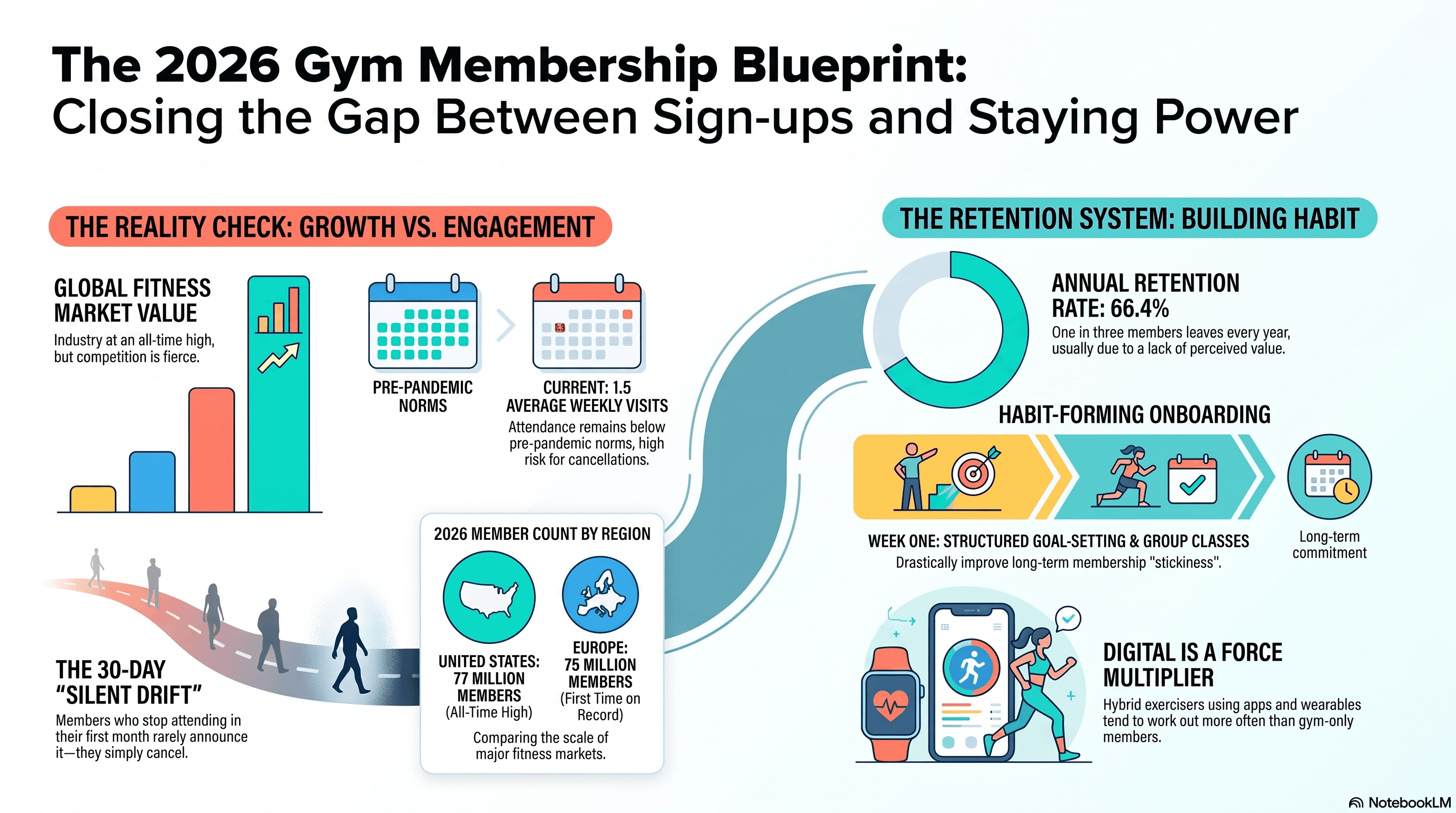
The global fitness market was worth roughly $131 billion in 2025 and is on track to keep climbing through 2026, according to Fortune Business Insights. In the United States alone, gym membership reached a record 77 million people in 2024, about one in four Americans aged six and up, per the Health & Fitness Association (HFA). Europe told the same story, crossing 75 million members for the first time on record (EuropeActive/Deloitte).
The takeaway for owners is simple: demand is real and still growing. But so is competition. There are well over 100,000 fitness facilities in the US market alone, and every one of them is chasing the same members you are. Growth does not guarantee your growth. It just proves the appetite is there for gyms that get the experience right.
The uncomfortable truth: most members barely show up
Here is where the picture gets more honest. Signing members up and getting them to actually train are two very different things.
- The average member visits their gym around 1.5 times per week, still below the norm of roughly 2.1 visits seen before the pandemic (HFA).
- Industry surveys have long estimated that a majority of members rarely or never use the membership they are paying for.
- Members who go quiet in their first 30 days are far more likely to cancel within six months.
That gap between who is paying and who is participating is the single biggest risk to your revenue. A member who stops showing up does not usually announce it. They just drift, and then one day they cancel. The gyms that win are the ones that can see the drift early and step in before it becomes a cancellation.
This is exactly why attendance visibility matters so much. When you can spot the member who has not checked in for two weeks, you still have time to bring them back. When you cannot, you only find out when the payment stops.
Retention is where the business is actually won
If there is one number to tattoo on the wall, it is this: the average annual member retention rate sits at about 66.4% (HFA 2025 Benchmarking Report). Roughly one in three members walks away every year.
And the leaving happens early. Around half of new members cancel within their first six months, and when members are asked why, cost is the most cited reason. But "too expensive" is very often shorthand for "I was not getting enough value." Members who feel progress, connection, and accountability rarely quit over price alone.
The encouraging part is that retention responds to effort:
- Members who go through structured onboarding and set goals in their first week are dramatically more likely to still be around six months later (IHRSA and Dr. Paul Bedford research).
- Members who attend group classes are meaningfully more likely to keep their membership than those who train alone.
- Members with a few friends at the gym are far stickier than those who train in isolation.
Notice what all three have in common: they happen in the first few weeks. Retention is not something you fix in month six. It is built in month one. The habit either forms early or it does not form at all.
Why January is a trap (if you stop at the sign up)
Every gym owner knows January is the big month. It accounts for roughly 12% of a year's sign ups. What is less talked about is the other side of that statistic: the large majority of those New Year joiners are gone within a few months.
The lesson is not that January is worthless. It is that a January sign up without a February and March follow up plan is just a delayed cancellation. Your resolution season strategy needs to run all the way through spring, with real activation touchpoints, such as a message when someone has not shown up, a nudge toward their first class, or a quick goal setting chat, not just a welcome email and a billing schedule.
Digital fitness is not the enemy. It is your ally
There is a myth that apps and home workouts are stealing members from gyms. The data says the opposite. The connected fitness market is growing fast, and hybrid exercisers, meaning people who combine the gym with app based or at home training, tend to work out more often than members who only use the gym.
That is a big deal. It means offering your members a digital layer, including progress tracking, coaching, community, and workouts they can take with them, does not pull them away from your floor. It deepens the relationship and gives them more reasons to stay engaged between visits. The members most plugged into fitness technology are often your most committed ones.
This is the whole idea behind Fitconnect. A member who can track their progress, follow a plan, and stay connected to their coach through an app is a member who is building a habit, and habit is what retention is made of.
What this means for your gym
Pulling the numbers together, five things stand out for 2026:
- The market is growing, so lean into it, but do not coast on it. Rising demand means more prospects and more competitors at the same time.
- Attendance is your early warning system. The member who stops showing up is the member about to cancel. Make participation visible.
- The first month decides the year. Onboarding, goal setting, and early engagement are where retention is actually built.
- January needs a full quarter plan, not a January plan. Follow up through February and March or watch four out of five resolution members disappear.
- Go hybrid. Digital tools strengthen the member relationship rather than competing with your floor.
The gyms that thrive in 2026 will not necessarily be the ones with the flashiest equipment or the lowest prices. They will be the ones that treat retention as a system, one that catches members at risk early, builds habits fast, and keeps members connected between visits.
That is the system Fitconnect is built to give you. If you would like to see how attendance tracking, member engagement, and the connection between coach and member come together in one platform, we would love to show you what your numbers could look like.
Sources: Health & Fitness Association (HFA) 2025 Consumer and Benchmarking Reports; EuropeActive/Deloitte European Health & Fitness Market Report 2026; Fortune Business Insights Global Fitness Market Report 2026; IBISWorld US Gym, Health & Fitness Clubs Industry Report 2024; IHRSA and Dr. Paul Bedford retention research. Figures reflect the latest available release for each metric and refer primarily to the US and European markets.